

Empty shoes…

They were the first thing I saw when we returned to my parents’ home from the hospital. Returned home from sitting vigil with my dad the final hours before his death. Returned home to an eerie emptiness that sucked the life out of me.

Daddy’s empty shoes.

I remember the surreal feeling in the hospital parking lot with my mom, brother, and sister. We had said our final goodbyes. Signed all the necessary papers. Zombie-like, we walked in silence to the car.

I remember feeling like the world as I had known it had ceased. There was a disconnect when seeing others laughing, smiling, continuing on with life as though nothing had happened. Nothing earth-shattering HAD happened in their worlds, but in mine… April 25th would never again be “just another day.” It would forever be the day my Daddy died.

That was over twenty years ago, and yet recently I’ve been grappling with similar emotions.

We’ve been counting down from 100 days until our departure from Thailand. Forty-two days until we leave this place that has been home for almost eleven years. Forty-two days before moving to our home country. Forty-two days until we are no longer “expats living abroad,” which has been part of our identity since 1979.

We’re in that surreal in-between time of disengaging from life here before re-engaging in another country, our “home” country. It’s strange to be with friends as they talk about plans for the upcoming Christmas season — realizing we won’t be here to go to the Christmas markets (always a great place to find unique, homemade gifts), watch the play a local theater group puts on each year, attend our church’s Christmas breakfast and service, take in a special holiday concert. It’s strange to realize we will no longer be a part of normal life here.

Yep. Life goes on.

Without us.

This is, of course, natural. OK. It happens! But just like my dad’s death, the finality associated with any kind of change means loss. And loss necessitates that it be acknowledged. And grieved.

I’ve been spending quite a bit of time lately reading and meditating on Psalm 121. Six times in this short psalm the word “keeps/keeper” is used:

… He who keeps you will not slumber.

…. He who keeps Israel with neither slumber nor sleep.

… The Lord is your keeper…

… The Lord will keep you from all evil;

… He will keep your life.

… The Lord will keep your going out and your coming in from this time forth and forevermore.

When something is repeated frequently it makes me wonder why. What’s the significance of the word “keeper/keeps”?

“Keep,in this context, comes from the Hebrew “shamar.” It has the idea of guarding, watching over, attending to carefully.

What an encouragement to me at this stage of our journey to be reminded that my God is guarding me, watching over me, attending carefully to me. He never gets tired. He never sleeps. He’s ever attentive and wants to protect me. He knows my comings and goings — both here and elsewhere. He is with me in ALL of the uncertainties, the changes, the challenges I face.

As I’ve been doing the “100-day countdown,” I’ve been listing things I’m going to miss living here in the tropics and things I’m looking forward to as we move to our home country (see blog post below where I first shared this idea). What’s been happening lately is that several things in the “miss” column have had their flip-side in the “looking forward to” column. For example, missing routine is paired with looking forward to reestablishing routine; missing familiarity with looking forward to eventually having things be familiar again — with an emphasis on the word eventually!

In the midst of change and the disconnect we’re now experiencing, I’m grateful that my husband and I are focusing on and clinging to the One who is the keeper of our souls. Some days my husband does better than I… other days I’m reminding him… but together we’re choosing to have joy in the journey of this thing called “Life!” A journey that has ups and downs, to be sure. But a journey in which God will continue to guard, watch over, and attend carefully to our steps.
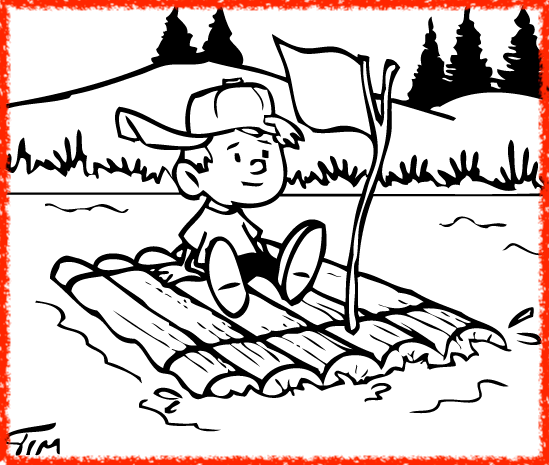

It’s time to build a R.A.F.T.

It’s rainy season here in the tropics. We sometimes joke with friends that it’s time to build an ark — like Noah did centuries ago when the whole world flooded. Thankfully, we live on the fifth floor of our building. Thankfully, we also live a good distance from a river that does, unfortunately, overflow its banks somewhat regularly.

But my husband and I are needing to build a R.A.F.T.

A raft is usually a temporary structure. Not something built to last forever, but something to cling to in the midst of stormy seas. Often rudderless, it’s at the mercy of the elements. It gets one from Point A to Point B — not as swiftly as something more sea-worthy nor as quickly — but it still accomplishes its purpose and “lands” one on another shore.

The late David C. Pollack (see below) developed a tool to help people like us who are in the midst of transition. He came up with an acronym that we’ve used in past moves… and are needing to use once again.

R = Reconciliation

Reconciliation means to reconcile with people. To make relationships right. Sometimes we think that if we just put distance between ourselves and whatever person or problem we struggle with everything will somehow be better once we relocate. BUT… those unresolved issues move with us. Broken relationships don’t just magically disappear. Reconciliation includes needing to forgive others and to be forgiven. A LOT of factors play into this, but at least as far as it depends on me personally, I need to intentionally do what I can to make sure I leave with no relational “stuff” hanging over my head.

Affirmation is another way to say “show appreciation.” Acknowledging what others have said or done to encourage us, to help make our stay here meaningful is a win-win situation. Too frequently, words of appreciation aren’t verbalized until it’s too late for the intended person to recognize the role they played in making a difference in our lives — think of eulogies at funerals. But by being intentional in communicating our appreciation, our thanks we validate the other’s impact and let them know how much they meant to us. This can be done either verbally (in-person) or by writing a note — and the more specific the better!

F = Farewells

Farewells… goodbyes are never fun. In fact, I really dislike them (see below for a blog written two years ago). Saying goodbye includes two crucial parts. The first is saying goodbye to people, places, possessions. If at all possible, revisit places that hold special memories. Be sure to schedule time with friends. If you are needing to downsize and get rid of possessions, take pictures of your favorites, and then”gift” them to friends so that you can visualize them still being enjoyed.

The second key part is to allow others to “farewell” you. This often feels quite awkward — after all, not many people enjoy being the center of attention! And yet this is important as much for those who will be remaining behind as for those leaving. It helps to give both parties closure.

T = Think destination

One of the most difficult parts about leaving a place is that one is, of necessity, simultaneously thinking through a gazillion details regarding the move AND thinking about what happens next. It’s like having one foot firmly planted in your current location — where everything is known, familiar, comfortable — while the other foot is firmly planted… in mid-air!?! Where are we going to settle? How will it be different from where we currently live? How will it be the same? What kind of community/support system will we have there?

A good friend, who has gone through several major moves with her family, suggested that my husband and I do a “100-day countdown.” The idea is that each day — for 100 days before we leave — we write down

  • One thing we are going to miss about living here.
  • One thing we are looking forward to when we move to our next destination.

Good advice! Especially since it will help us focus on the positives.

Yes, we’re starting to build a R.A.F.T. We recognize that we’re in this strange in-between time of disengaging from here before re-engaging elsewhere. There undoubtedly will be stormy seas as we move from Point A to Point B , but our “raft,” although temporary, is vital to enable us to leave well… so that we can enter well… so that we can live well… and have joy in the journey of this thing called “Life!”