
Fare thee well…

photo credit: http://www.postermywall.com

Well, we made it. My husband and I have been back in our home country a week now. Moving from the tropics to a wintry climate, exchanging flip flops and shorts for multiple layers and yet still being cold… it’s an adjustment to be sure! A crackling fire on the TV screen gives the illusion of warmth and coziness. But hey, I’ll do anything I can to fool my body into thinking I’m warm!

The past two months have been a whirlwind of goodbyes, closing out bank and internet and phone accounts, selling our car, rehoming most of our possessions so that we could travel with only four suitcases (three of the four being overweight, but thankfully the airlines were gracious!), scurrying to be all done with packing and moving so that we could have our “boat days….”

When I took time a couple of days ago to reflect on all that has transpired, I realized that our current physical tiredness is partly due to jet lag — after all, there’s a twelve-hour time difference from where we lived to where we now are! But probably more of the exhaustion comes from fatigue. Decision-fatigue. Moving-fatigue. Goodbye-fatigue.

In other words, emotionally draining stuff.

Back in August I wrote about the importance of building a R.A.F.T. (see link below) The acronym refers to key elements to leaving a place well so that one can enter the next place well.

  • R = Reconciliation: making sure relationships are right.
  • A = Affirmation: acknowledging what others have said or done to encourage us, to help make our stay here meaningful.
  • F = Farewells: saying goodbye to people, places, possessions… AND allowing others to “farewell” you.
  • T = Think destination: thinking about what happens next.

My husband, who is an introvert and behind-the-scenes type of guy, wasn’t so sure about the farewell stuff. I didn’t nag or pressure him — really! He saw that it was important to me, and so acquiesced. Two events in particular ended up being a huge encouragement to both of us… and helped us to see the value of being “farewelled.” Those events provided a sense of closure to a major chapter in our lives. They helped us to say goodbye. To prepare mentally and emotionally for this next chapter. To leave well.

This made me wonder… are there any farewells in the Bible??? What, if any, similarities do they have with what we’ve experienced? What can I learn from their example?

When Moses was nearing the end of his life, his parting words to his protege Joshua were…

Be strong and courageous.

Do not fear or be in dread of [the people of the land he was going to conquer],

for it is the Lord your God who goes with you.

He will not leave you or forsake you.

— Deuteronomy 31: 6

When King David’s time to die drew near, he said to his son Solomon…

Be strong….

keep the charge of the Lord your God, walking in His ways and keeping His statutes, His commandments. His rules, His testimonies…

— I Kings 2: 2-3

After Jesus’ death and resurrection, He appeared to His disciples before ascending into heaven and said to them…

All authority in heaven and on earth has been given to me.

Go therefore and make disciples of all nations, baptizing them in the name of the Father and of the Son and of the Holy Spirit, teaching them to observe all that I have commanded you.

And behold, I am with you always, to the end of the age.

— Matthew 28: 18-20

These farewells included…

  • encouragement to be strong… to be courageous
  • encouragement to not be afraid
  • a reminder that God would be with them… they wouldn’t be alone… He would never leave them or forsake them… He would be with them forever
  • instructions on how to live life according to God’s plans and ways

Yep. Farewells are important. They’re an integral part of life. They help us as we move from one country to another; from one job situation to another; from one season of life to another. From the familiar to the unknown.

We’re not sure what this new chapter of life will look like for us… but we ARE sure that we are not going it alone. That God is with us and will be guiding us. That He’s rooting for us and encouraging us to be strong, to be courageous, to not be afraid.

We’re ever so grateful that we have His Word — the Bible — to instruct us on how to live life according to His plans and ways. And that, dear friends, is how we’ll have joy in the journey of this thing called “Life!”

Storms of life…

photo credit: Ashley Haack Fine Art

I LOVE the sea! Having grown up near the ocean and having spent countless hours swimming, sailing, water skiing, and walking on the beach, being on or near water truly is my happy place. There’s something about watching the never-ending cycle of waves crashing onto the beach — or even when the sea is merely gently caressing the shore — that calms me. Restores me. Nourishes my soul. Reminds me that my Creator God is likewise constant, consistent, dependable, steady.

But sometimes the sea can be frightening. Overpowering. An adversary to be subdued rather than an ally to be enjoyed. Watching a storm from the safety of the shore is vastly different from being in the midst of the angry waves, tossed to and fro at the mercy of nature. Add to that being pelted by rain or sleet or snow. Lightning flashing. Darkness that engulfs and disorients. Feeling like there is no escaping destruction and loss of life.

There’s a story in the New Testament of the Bible about a sea voyage that took place in the first century. It was a journey that started in Caesarea (on the eastern-most shore of the Mediterranean Sea) and eventually ended in Rome (complete opposite direction).

map of Paul’s Journey to Rome from Olive Tree Bible App

The journey was a challenging one from the start. It started late in the season for sea travel. The initial small vessel wasn’t adequate for the open-sea voyage. Stormy winds blew them off course before they had gotten halfway. The wind was “tempestuous,” which is how we refer to a northeaster in today’s parlance. Such storms appear suddenly, often with violent, whirling winds. They had to stop and take shelter several times.

An additional problem was that the vessel was transporting a man named Paul. He was a God-fearing man who was on his way to Rome to stand trial before Caesar. Paul had warned the captain and crew that the journey would more than likely result in the loss of the ship, cargo, and lives. His warning went unheeded.

They went without food for fourteen days. They had to jettison the cargo. Then they had to get rid of the ship’s tackle. Some of the crew panicked and wanted to escape using the ship’s dingy. BUT Paul warned that doing so would put everyone in jeopardy.

Soon afterwards the vessel ran aground and the stern broke apart in the surf. None of the 276 men on board were lost… but the journey wasn’t over yet! They were only as far as the island of Malta.

… the rest of the story is for another time…

Paul had an unshakeable belief that IF those on the ship did what he suggested all would go well.

… the God to whom I belong and worship…said,
“Do not be afraid, Paul;
you must stand before Caesar.
And… you and all who sail with you [will be safe.]”

So take heart, men,
for I have faith in God
that it will be exactly as I have been told.
But we must run aground on some island.

Acts 27: 23-26

Note that he didn’t say that it would be smooth sailing. But rather in the midst of the storm, all would be well.

Sometimes life feels like being in a storm. We start our journey well… and then “stuff” happens that blows us off course. We lose our bearings. We feel as though we’re being pummeled from all sides with the relentless intensity of circumstances out of our control. Hopelessness and fear engulf us. In our panic, we jettison those things that normally would help keep us upright.

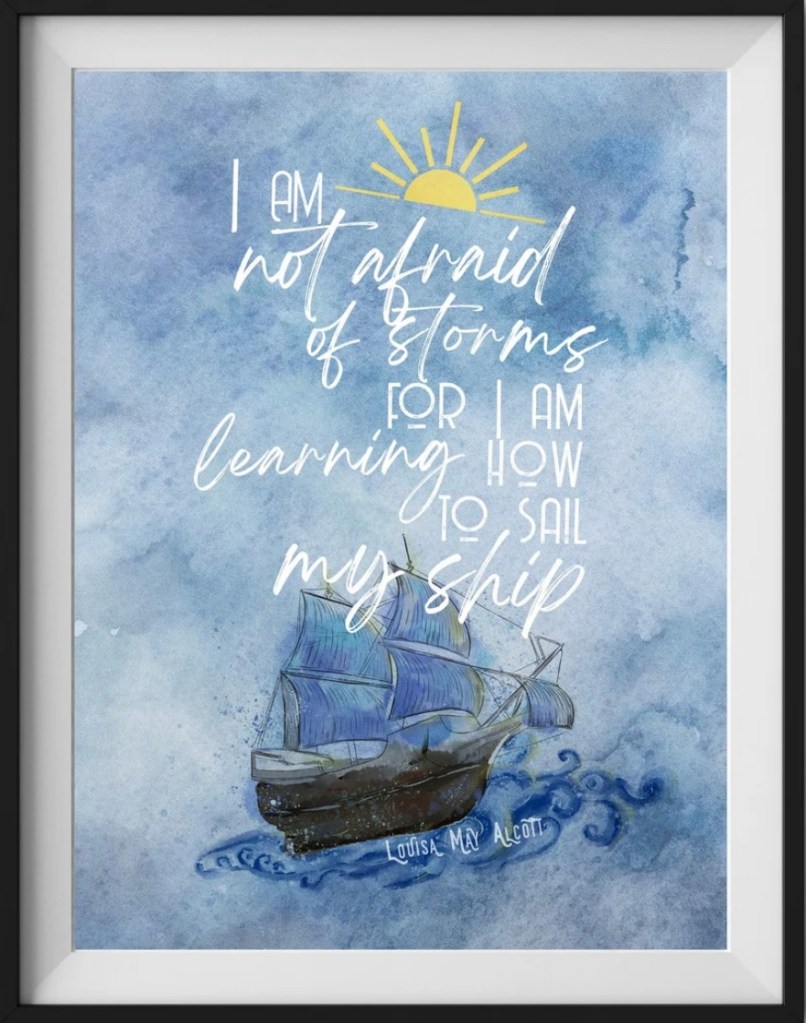
I am not afraid of storms
for I am learning how to sail my ship.

Louisa May Alcott, from her book “Little Women”

From my perspective, it seems that sometimes being “blown off course” is actually more of a detour, a way God uses to get me where He wants me — in HIS timing, not mine. Wanting to jump ship, to try to figure things out and manipulate the results usually is counter-productive. In all honesty, I can feel overwhelmed. Abandoned. Fearful. Hopeless. But the more I get to know God, the more I realize that He is a loving Father who is with me in the midst of the storms, never abandoning me. Never wishing me harm. Wanting me to trust that HE is in control. He has His hand on the rudder and will guide me safely to port.

I’m learning to not be afraid of life’s storms. I’m learning how to sail my ship. I’m learning that wherever my ship goes — by whatever circuitous route, in whatever time frame — I’m not alone.

And may that become true for you as well, dear reader, so that together we may have joy in the journey of this thing called “Life!”

to read more about this sea voyage, see Acts 27:1 – 28:14

… neither listened… nor…???

The phrase jumped off the page as I was reading.

“They neither listened nor obeyed.”

It was in reference to the Israelites back in the 8th century BC. The nation had split in two several hundred years earlier. Both the northern and the southern kingdoms were governed by a series of kings, most of whom were jerks. Over and over again God gave them wake up calls to try to get their attention. To try to get them to listen to Him and to keep their part of the bargain (a covenant) they had made with God. They openly defied the clear instructions He had given them, which would’ve ensured that they lived peacefully and productively in the new land they were inhabiting. They were stubborn, defiant, willful. They dishonored and disregarded everything that God had made holy.

Finally, enough was enough!

And so God sent Shalmaneser, the King of Assyria, to carry the northern kingdom into exile. Why?

“... because they did not obey the voice of the Lord their God… they neither listened nor obeyed.”

2 Kings 18:12

It’s bad enough not to obey God… to do what He has told you to do. But to not even listen… that inhibits any awareness of learning what’s on His heart, of even wanting to do so. It cuts off any chance of clearing up misunderstandings. Of being open to considering the possibility that I may be wrong. That my perspective/assessment of a situation is skewed. Of acknowledging wrongs and being forgiven.

I do it, though. Unfortunately. I have “selective listening” — choosing what I want to hear and blocking out the rest. And this doesn’t only refer to God, but also to other people — like my husband! He admits that he is also guilty of “selective hearing” and shares how, early in our marriage, he would sometimes feign listening to me while sneaking peeks at a chess magazine in his lap. Needless to say, that didn’t go over very well! And working on our communication skills has been an on-going theme in our marriage.

Sometimes I don’t hear well because my ears are literally blocked. Sounds become muffled due to a build-up of earwax. Getting rid of stubbornly embedded wax requires the intervention of a skillful physician. And it can be painful.

God is that skillful physician in my life. Rooting out whatever is blocking my ability to hear Him. Applying pressure when necessary. Rinsing, so to speak, with warm water, flushing out whatever tenaciously clings to me.

It’s a poor commentary on the Israelites when they are labeled as “neither listening nor obeying.” And it’s a poor commentary on me as well.

Lord, open my ears that I may hear Your voice — all of what You say and not what I pick and choose. And enable me to obey — wholeheartedly. Unreservedly. Without questions asked. I dishonor You when I pick and choose my way through life. Forgive me. So many voices are vying for my attention these days. Help me to intentionally block them out so that I hear Your voice above all others.

And that, my friends, will help me — and hopefully you — to have joy in the journey of this thing called “Life”!

The Oatmeal Crew…

It was the summer before I graduated from university. I was working as a chambermaid in a hotel at the beach. Every morning I would make a small bowl of oatmeal before heading off to work. Plain. Nothing added besides some milk… maybe a smidgen of brown sugar??

I shared the basement kitchen of an old hotel/now boarding house with a bunch of other college students. We didn’t have much money, and so were frugal regarding what groceries we bought.

About the same time each morning I was making my breakfast a bunch of guys were making a BIG pot of — you guessed it, oatmeal! One day they asked if I would like to share from their pot, which only made sense, right?! And so I became a part of the “Oatmeal Crew.”

That group became a very important part of my daily life. It helped me begin to understand the importance of community… of having a group of like-minded people to share life with… a group who was pursuing the same goal.

Fast forward to today… My husband and I have been talking through our upcoming move to our home country later this year. One of the key factors we’re considering regarding where we will relocate is community.

As Christ-followers, it will be important for us to find a body of like-minded people with whom to begin cultivating that sense of community. A church is a good place to start.

In addition, wherever we’ve lived over the years we’ve always been intentional getting to know our neighbors. People older and younger than we. People who believe differently… or don’t believe at all. People from all different walks of life, cultural backgrounds. Our lives have been enriched because of the many people we’ve rubbed shoulders with over the years. And so I’m anticipating that we’ll do this wherever we end up living!

We’ll also be looking for ways to plug in… to be involved in the lives of others. Ways to start building community.

We’re in a different season of life this time around. Our capabilities and limitations are somewhat different from when we first moved overseas 46+ years ago. And yet I’m encouraged by a lesson from the life of Christ.

Jesus and his followers were faced with a bit of a dilemma. A large crowd — at least 5000 — had followed them to the mountains. Everyone was hungry, but a few problems emerged.

First problem: there wasn’t a grocery store out there in the middle of nowhere where they could buy food!

Second problem: even if there were a store, how could they possibly purchase enough food to feed that many people?!

A young boy had five loaves of bread and two fish. Hardly seems like that could make a dent in feeding so many people! But miraculously, after Jesus gave thanks for this meager gift, not only was there enough food but also there were twelve FULL baskets of leftovers!

So… what’s the lesson for me?

Did it matter how many loaves of bread Jesus had? or how many fish? Nope. He took what the boy had and accomplished what needed to be done. All it took was a willingness on the boy’s part to offer to Jesus what he had.

… a willingness to offer to Jesus what he had…

At this season of life I may not have the energy I had in my 20s… but whatever I give to the Lord to use, He can use! What’s important is for me to be willing. To be willing to offer to Jesus whatever I have. To not try to out-think God (perish the thought!) regarding what I can and cannot do. (Yes, I have a tendency to do that. But I’m working on learning to more consistently apply the wisdom of the following…)

Trust in the Lord with ALL your heart, and lean not on your own understanding. In ALL your ways acknowledge Him, and He will make straight your paths.

Proverbs 3: 5-6

Wherever we end up living, wherever we start building community, my desire is to use whatever gifts and abilities I have, whatever energy or lack-thereof I have, whatever resources (financial, spiritual, mental) I have to help advance God’s Kingdom here on earth. I’m trusting that God will take my loaves and fishes and multiply them according to His plans and purposes.

Sounds exciting, right?! And scary. But the lesson from the Oatmeal Crew continues to impact my life, especially since I ended up marrying one of the guys! Together, he and I are looking forward to whatever our future holds. Together, we’re anticipating that we’ll continue to have joy in the journey of this thing called “Life!”

PS You can read the story of the loaves and fishes in the New Testament book of John, chapter 6.

PS #2 To read more about the summer I was a chambermaid, see this earlier blog:

Filling in the blanks…

Ok. I admit it. I’m a slow-waker-upper. My husband used to say that when I first woke up I would bounce from wall to wall in search of caffeine. My sister, on the other hand, is wide awake and bushy-tailed the moment her feet hit the floor! I have improved over the years, thankfully… but I’m definitely NOT a morning person.

And so when my husband and I went for a walk a few mornings ago you now can understand why he was so perplexed when I pointed to a dead bird on the path. “Bird?” he said. “Does a bird have pincers?!?”

In my not-quite-alert state I had briefly glanced at what looked to me like a baby bird. I filled in the blanks, made an assumption, and announced, “Watch out! There’s a dead bird on the ground!”

I didn’t look closely to see what was actually on the ground.

I’m not alone in filling in the blanks, not looking closely at a situation, coming to erroneous conclusions. The Israelites fell into that trap several times.

Once they entered the Promised Land, the Israelites engaged in military campaigns to conquer the territory. Their mandate: annihilate the inhabitants and take over the land. Sounds brutal, and it was! Their first conquests instilled fear in the hearts of the people in the remaining territories. The inhabitants’ hearts melted and there was no longer any spirit in them because of the people of Israel (Joshua 5:1).

The city of Gibeon decided on a plan to trick the Israelites into making a treaty with them, a treaty that would obligate the Israelites to come to their aid if the Gibeonites were attacked. They came up with an elaborate deception to save themselves from what would be certain death once the Israelites invaded their city.

They went to the camp of the Israelites with worn-out sacks on their donkeys. All their provisions were dry and crumbly. Their wineskins were split open and mended. Their sandals were patched and they wore worn-out clothes. They said, “We have come from a distant country, so now make a covenant (treaty) with us.”

Joshua, the leader of the Israelites, was skeptical. He even wondered if these people lived among them. But the Gibeonites were very convincing.

From a very distant country your servants have come, because of the name of the Lord your God. For we have heard a report of Him, and all that He did in Egypt… and to the two kings of the Amorites… So our elders and the inhabitants of our country [sent us to you]… This bread was hot from the ovens when we left our homes. But now it is dry and moldy. These wineskins were new when we filled them, but now they are old and split open. And these garments and sandals are worn out from the very long journey.

Joshua 9: 9-13

The Israelites examined the Gibeonites’ food — did a quick look/see — but didn’t ask God if it was a good idea to enter into an agreement with these strangers. And so Joshua made a treaty with them.

Three days later the Israelites learned that these people actually lived nearby. And because of the treaty, the Israelites were now obligated to protect the Gibeonites from any attacks from enemy nations.

Filling in the blanks. Glancing at a situation, not looking at it closely. Failing to be discerning. Not seeking God and His wisdom.

Ouch! I realize I sometimes fall into the same trap. I hastily read a text or half-listen to a conversation… and fill in the blanks of what I think the other person was wanting to communicate. I look at worn-out sacks, wineskins, clothes — in other words, outer appearances — and fill in the blanks, jumping to conclusions about a person. I neglect to first ask God what HE wants me to do — filling in the blanks with my very limited knowledge and wisdom.

Live and learn, right?!? Hopefully! May we take to heart yet another lesson from the children of Israel and NOT fill in the blanks, but rather learn to be more discerning. And together, may we have joy in the journey of this thing called “Life!”

By the way… the “bird” was actually a crab!

At sixes and sevens…

That’s the way today’s journal entry started…

Finding myself at sixes and sevens...

I got to thinking… what on earth does this expression actually mean?? How did it enter the English language?? I know how I was feeling… at odds with myself. Not sure what to do next. Not really in a funk… but… well, at sixes and sevens.

A little sleuthing, courtesy of Wikipedia, says at sixes and sevens is an English idiom used to describe a condition of confusion or disarray. It dates from the mid-1380s meaning “to hazard the world” or “to risk one’s life.”

Various states of confusion and risk are true of our household right now.

A few months ago I blogged about our “trifecta” (see link below). Several major decisions had converged upon our lives. One by one, clarity has come. One by one, decisions have been made. One by one, we’re moving ahead… into a new chapter of our lives.

That’s where confusion and risk fit in. My husband and I have made the decision to move back to our home country… after 46+ years of living abroad! We don’t have to learn another language, thankfully! But a LOT has changed — both in our home country and in our lives individually and as a couple — since we first moved overseas as almost newlyweds (we celebrated our third wedding anniversary a couple weeks after arriving in Europe a “few” years ago).

Uprooting and then resettling yet another time is filled with a myriad of decisions, emotions. Sometimes it’s overwhelming. Scary. Other times, exciting!

And then there’s a day like today… when I’m at sixes and sevens. After sharing our news with our families, we started spilling the beans to good friends. No one has been all that surprised — actually, they seem rather excited! But sharing this news face-to-face with someone yesterday and another friend today… well, the reality of this decision and all it entails keeps sinking in. Keeps becoming more and more real.

I’m already making mental lists of things I’ll miss living here in the tropics, like the daily serenade of birds I listen to each morning as I sit in my living room spending time with God. And mental lists of things I’m anxious about with our upcoming move, like WHERE will we end up living???

I’m feeling a bit like the Israelites that I’ve been blogging about lately. We’re on our own journey in the “wilderness” on our way to the “promised land.” The journey is fraught with detours, challenges, unknowns, potential misunderstandings.

Hmm… do you think God may have had me reading that portion of the Bible because He knew what was coming down the road for us?!? That there were lessons to be learned from the Israelites that would help me today?!? In the 21st century?!? I’m inclined to think YES!

Be strong and courageous. Do not be frightened or afraid, and do not be dismayed [surprised, disillusioned, disappointed] for the Lord your God is with you wherever you go. Joshua 1:9

… in quietness and in trust is your strength… Isaiah 30:15

These are some of the things I’m focusing on during these topsy-turvy days. Things that I know are true. Things that will help me keep my focus on God. Things that will enable me to trust HIS plans — even though they aren’t all crystal clear to us yet! I’m confident that by doing so, there will be joy in the journey of this thing called “Life!”

Pop quiz… and I flunked!!!

photo credit: redbubble.com

Mrs. Warren’s trigonometry class. Or was it Mr. Schneller’s chemistry class? The words “POP QUIZ” instilled fear in my heart as a high school student. Would I remember what had been taught the day before? Why am I drawing a blank on this formula? Why did I procrastinate doing my homework?!? Ugh. Should’ve paid better attention. Should’ve been better prepared. Should’ve gone to bed earlier so that my brain wasn’t so fuzzy.

A few weeks ago I wrote about the danger of making assumptions. And, as often happens, life sometimes gives us a pop quiz to see how well we’ve learned our lessons. In other words, do I practice what I preach — or in this case, blog about??

Well, two days ago I had a pop quiz.

We get together weekly with some friends for Bible study and prayer. A time of hanging out with one another — catching up on what’s been happening in our lives. One couple couldn’t come because they were sick. Another couple said they had a conflict and also wouldn’t make it.

At least that is what I assumed.

We then got together for dinner with a third couple from our group. BUT… we received a text from the couple I had assumed couldn’t come wondering where and when the group would be meeting.

On, no!!! What have I done?!?

Pop quiz on assumptions! And I flunked! As a result, I now needed to talk this through with the others so that my goof doesn’t cause any additional misunderstandings and/or negatively influence our relationships. Ugh.

I’m not the only one who flunked a quiz on assumptions. Our friends the Israelites flunked BIG TIME!

After the incident I shared about in the “Danger of Assumptions” blog (see link below), the Israelites — both those who had settled on the western side of the Jordan River and those on the eastern side — joined forces to conquer the land.

So far, so good.

The land was conquered. Everyone went home. But before the eastern tribes returned to their homes across the Jordan River, they built a large altar. The other tribes — the ones who lived on the western side of the river — had a fit! They assumed the worst.

[We, the western tribes] demand to know why you [the eastern tribes] are betraying the God of Israel. How could you turn away from the Lord and build an altar for yourselves in rebellion against Him?… today you are turning away from following the Lord. If you rebel against [Him] today, He will be angry with all of us tomorrow… do not rebel against the Lord or against us by building an altar other than the one true altar of the Lord our God.

Joshua 22: 16-19

They were SO angry about this that they were ready to make war against their fellow Israelites!

Fortunately, instead of taking matters into their own hands and starting a war, they first sent a delegation to check things out. AND… what had been an erroneous assumption was cleared up.

The truth is, we [the tribes of the eastern side of the river] have built this altar because we fear that in the future your descendants [those on the other side of the river] will say to ours, ‘What right do you have to worship the Lord, the God of Israel? The Lord has placed the Jordan River as a barrier between our people and [yours]. You have no claim to the Lord.’

So your descendants may prevent [ours] from worshiping the Lord. So we decided to build the altar… as a memorial. It will remind our descendants and [yours] that we, too, have the right to worship the Lord… it is a reminder of the relationship both of us have with the Lord.

Joshua 22: 24-28

Whew! A bloodbath averted.

I’m adding a few items to my list of things being learned about assumptions:

  • Beware of jumping to conclusions!!!
  • Make it a habit to first verify ALL the info… to make sure you’re not missing something or misreading the situation.
  • Lay aside your own prejudices and preconceived ideas.
  • Recognize that our own impatience often adds fuel to the fire! It’s better to err on the side of caution than to barge ahead only knowing part of the story.
  • Cultivate a habit of listening not only to the other person’s words but also to their heart. To the unspoken things that are “heard” by paying attention to one’s countenance and body language.
  • Recognize how wanting to stick to OUR agenda, OUR plans can hijack our perspective.

Back to my dilemma… I talked with our friends. Everything was resolved. And now, thankfully, I can — without regret or wondering if everything is ok — continue to have joy in the journey of this things called “Life!”

Heart on paper…

One of the reasons I first started writing was to figure out what was going on inside my head… inside my heart. It somehow seemed to help when I “verbalized” whatever I was going through in black and white… with pen and paper.

One writing in particular still stands out in my memory. I remember when it was written. Where I was. What I was struggling with…

I was a freshman at university. It was a cold, dreary winter day. I had driven our family’s big, yellow station wagon over to “the Fort,” a local beach that to this day is my all-time favorite beach because of its pristine, uncluttered shoreline. I was trying to figure out who I was… what life is all about… how God fits into the picture, IF He does.

I vividly remember the way the sky looked. Threatening… yet at the same time, hopeful. Sun rays were peaking through the gloom. As if God were reaching down from heaven, reaching out His hands to me, wanting to pull me out of my despair and confusion.

Unfortunately, what I wrote that wintry day got lost over the years. But I still look back on that day as when I began to value putting my heart on paper.

Fast forward to today…

As I’ve been reading through the Old Testament of the Bible, I’m increasingly overwhelmed by seeing the heart of the authors on paper. I’m at that point in the story where the children of Israel are about to enter the Promised Land. They’ve been wandering in the wilderness for forty years (due to the disobedience of some of their leaders). They’ve been given directives as to how to best represent God to the people and nations they are preparing to conquer. They’ve been on a roller coaster of doing the right thing, blowing it, saying they’ll do better the next time… kinda sounds a lot like me!

Moses, their leader, is now 120 years old. He personally has been barred from entering the Promised Land because of losing his temper and not doing what God told him to do (see Numbers 20:12, Deuteronomy 3:23-28, and Psalm 106:32-33). In the book of Deuteronomy, Moses’ heart on paper jumps off nearly every page as he prepares the people for what lies ahead, reminding them of all that God has instructed. Reminding them of where they have come from and what is expected of them.

  • Do not fear of be dismayed… (1:21)
  • Do not be in dread or afraid of [the enemy]. The Lord your God who goes before you will Himself fight for you, just as He did for you in Egypt before your eyes, and in the wilderness, where you have seen how the Lord your God carried you, as a man carries his son… (1:29-31)
  • … listen to the statutes and the rules that I am teaching you, and do them, that you may live, and go in and take possession of the land… (4:1)
  • Only take care, and keep your soul diligently, lest you forget the things that your eyes have seen, and lest they depart from your heart… (4:9)
  • … watch yourselves very carefully. (4:15)
  • … beware lest you act corruptly… (4:16)
  • … beware lest you raise your eyes to heaven, and when you see the sun and the moon and the stars, all the host of heaven, you be drawn away and bow down to them and serve them… (4:19)
  • Take care, lest you forget the covenant of the Lord your God… (4:23)
  • … be careful… to do as the Lord your God has commanded you. (5:32)
  • … be careful to do [all God’s statutes and commands], that it may go well with you… (6:3)
  • … remember what the Lord your God did to Pharaoh and to all Egypt, the great trials that your eyes saw, the signs, the wonders, the mighty hand, and the outstretched arm, by which the Lord your God brought you out. So will the Lord your God do to all the peoples of whom you are afraid. (7:18-19)
  • … be careful to do [the whole commandment that I command you today] that you may live and multiply… (8:1)
  • … remember the whole way that the Lord your God has led you these forty years in the wilderness, that He might humble you, testing you to know what was in your heart, whether you would keep His commandments or not. (8:2)
  • Take care lest you forget the Lord your God by not keeping His commandments and His rules and His statutes… (8:11)
  • Beware lest you say in your heart, ‘My power and the might of my hand have gotten me this wealth.’ (8:17)
  • Remember and do not forget… (9:7)
  • … consider the discipline of the Lord your God, His greatness, His mighty hand and His outstretched arm… (11:2)
  • Take care lest your heart be deceived, and you turn aside and serve other gods and worship them… (11:16)
  • Take care that you do not offer your burnt offerings at any place that you see, but at the place that the Lord will choose… (12:13)
  • Be careful to obey all these words that I command you, that it may go well with you and with your children after you forever… (12:28)
  • … take care that you be not ensnared to follow [the enemy nations] after they have been destroyed before you, and that you do not inquire about their gods… (12:30)
  • … remember that you were a slave in the land of Egypt, and the Lord your God redeemed you… (15:15)
  • … remember that you were a slave in Egypt; and you shall be careful to observe these statutes. (16:12)
  • … let not your heart be faint. Do not fear or panic or be in dread of [the enemy], for the Lord your God is He who goes with you to fight for you against your enemies, to give us victory. (20:3-4)
  • … be careful to do [these statutes and laws] with all your heart and with all your soul. (26:16)
  • Be strong and courageous. Do not fear or be in dread of [the enemy], for it is the Lord your God who goes with you. He will not leave you or forsake you. (31:6)

Do you hear it?? Do you hear Moses’ heart?? Over and over again… like a parent getting ready to launch their child into the world. Do not fear. Do not be dismayed. Do not be in dread. Do not be afraid. Listen. Take care. Watch yourselves. Beware. Be careful. Remember. Consider. Do not forget. Be strong and courageous. God goes with you. He will not leave you or forsake you.

Moses’ heart on paper mirrors the heart of God.

God, our Father, over and over again wants us to know how much He loves us. How much He wants us to listen to Him and follow His instruction manual for life, the Bible. Just as those rays peaking out from behind gray clouds years ago were “reaching” for my heart so that I would turn to Him, so today God is reaching out to you, dear friend, to draw you to Himself, to encourage your heart, to guide you. In the words of Moses, “take care” that you avail yourself of all that God has to offer, and together we’ll have joy in the journey of this thing called “Life!”

The danger of assumptions…

photo credit: hrdailyadvisor.com

It was the summer before graduating from university. I had gotten a job as a chambermaid at a hotel in a resort town at the beach. My co-workers and I wore turquoise blue dresses as we changed beds and cleaned bathrooms. Yes, dresses. It was the 70s after all! We also wore “sensible” shoes because of being on our feet all day long.

When preparing a room for new guests, I left a little booklet on the bedside table that told a bit about me: what I was studying at university, what my interests were, what I was hoping to do after graduation. It also included a brief summary of the decision I had made two years earlier to become a Christ-follower, and explained how one might initiate a personal relationship with Christ like I had done.

One morning, a little girl stood in the hallway intently staring at me as I prepared to clean her family’s room. She had a perplexed look on her face, a look of total confusion. She finally blurted out, “I thought you were a nun, but I’ve never seen one dressed like you!”

She had made the assumption that a) the booklet I had left in their room indicated I was a “religious” person and since b) the religious people she knew were all dressed in black habits — not turquoise blue dresses! I must therefore c) be a nun!

Jumping to conclusions. Making assumptions. We’re all prone to do it. But the results can be much more serious than assuming one’s wrong occupation like the little girl did so many years ago.

Another case of making an erroneous assumption is recorded long before that encounter at the hotel when I was in university. This time we read about it in the Old Testament book of Numbers.

The Israelites were preparing to enter the Promised Land. FINALLY! They had wandered in the wilderness for forty years, and now were getting final instructions before conquering and dividing up the land they were to inherit. Two of the tribes (Reuben and Gad) wanted to stay on the East side of the Jordan River. They raised livestock, and that land was more conducive for their herds than the land on the other side of the river. They very respectfully went to their leader (Moses) and requested permission to settle there.

Moses had a fit! He got really angry!

Do you intend to stay here while your brothers [the other tribes of Israel] go across and do all the fighting? Why do you want to discourage the rest of the people of Israel from going across to the land the Lord has given them? Your ancestors [the ones who had earlier spied out the land] did the same thing… they discouraged the people of Israel from entering the land the Lord was giving them… Here you are, a brood of sinners doing exactly the same thing! You are making the Lord even angrier with Israel. If you turn away from Him like this and He abandons them again in the wilderness, YOU will be responsible for destroying this entire nation!

Numbers 32: 6-15

He assumed their request meant the men would not join the other tribes in going to battle to conquer the land, but rather wanted to take the easy way out, staying on “their” side of the river.

Wrong!

The tribes of Reuben and Gad then explained to Moses that they were willing to arm themselves for battle and join the others. They simply wanted to get their families and livestock situated before doing so.

We simply want to build pens for our livestock and fortified towns for our wives and children. Then we will arm ourselves and lead our fellow Israelites into battle until we have brought them safely to their land. Meanwhile, our families will stay in the fortified towns we build here, so they will be safe from any attacks by the local people. We will not return to our homes until all the people of Israel have received their portions of the land. But we do not claim any of the land on the other side of the Jordan. We would rather live here on the east side and accept this as our inheritance.

Numbers 32:16-19

Wrong assumptions can be deadly. By misreading a situation, we’re prone to jump to wrong conclusions. We don’t understand motives, often guessing at them. Often guessing wrong.

We sometimes (almost all the time??) don’t let the other person explain their thinking. We barge ahead, not listening — because we’ve already made up our mind. We usually assume the worst.

Wrong assumptions can destroy relationships. We become suspicious. They foster wrong thinking. We end up shrinking back from saying or doing something.

Hmm… what can I learn from all this?

  • Take time to listen… really listen.
  • Avoid the tendency to cut the other person off because you think you know what they will say or what they want to do.
  • Choose to believe the best about others — instead of jumping to the worst, often negative, conclusions.
  • Be open to seeing things from a different perspective.
  • Ask questions to clarify any potential misunderstandings.

There’s another incident of misjudging motives and jumping to wrong conclusions once the two tribes finished helping the others conquer the land and were returning to their homeland. But I’ll save that for another blog.

In the meantime, I’m guessing this is something that isn’t a one-time-got-it-all-figured-out kind of thing. But rather something we ALL need to grow in.

We’re ALL in process. But hopefully together, we can have joy in the journey of this thing called “Life!”

Betrayal…

The description pierced my heart. The emotions conveyed so raw, so poignant. The narrator describing his restlessness. Being in anguish. Overtaken by fear and trembling and horror.

But what was even more shocking was the source of all this turmoil. It wasn’t an enemy taunting him, arrogantly insulting him — something he could’ve handled. It wasn’t some other adversary — then he could’ve hidden.

It was his friend.

The narrator lived centuries ago. His name is David, once a shepherd boy and later a king. He goes on to describe this “friend” in Psalm 55 of the Bible.

  • He was his equal, his companion, his close friend.
  • They used to do things together, support and encourage each other.
  • He betrayed his friends.
  • He broke his promises.
  • His words were smooth as butter… yet they were drawn swords.

The anguish David expresses literally jumps off the page. It emphasizes how nothing so pierces and destroys our hearts like the stabs of someone we’re close to. Someone we once trusted.

This week is what is referred to in the Christian calendar as Holy Week. It’s the period of time spanning Jesus’ triumphant entry into Jerusalem riding on a donkey (Palm Sunday), the Last Supper (when He celebrated the Passover meal with His disciples and then was betrayed by one of them), the Crucifixion (what is referred to as Good Friday), and Easter (the day He was resurrected from the dead).

A gut-wrenching part of Holy Week occurs when Judas, one of the twelve disciples, sold Jesus out for thirty pieces of silver. Sold Him to those who wanted Him dead.

Judas had been with Jesus for three years. He was part of the group of twelve who followed Christ all over the countryside, learning from Him, observing miracles, seeing lives transformed. Wouldn’t you think that after all that time together Judas would have a deep, intimate relationship with Jesus? A relationship built on trust? A relationship that would mean more than a handful of coins?

Trust is the foundation of any relationship. But when that trust is broken, when one is betrayed the results are devastating.

Sadly, our world is filled with the aftermath of betrayal...

  • Marriages that end in divorce.
  • Friendships that dissolve.
  • Working relationships that disintegrate when one person does all the work but someone else gets the credit/recognition/a bonus.
  • Even our bodies betray us as we age: forgetfulness, sore/stiff joints, sagging muscles replace our once vibrant selves.
  • Some would feel the church has also betrayed them, citing hypocrisy and lack of authenticity as reasons to give up on anything related to God.

What a bleak picture!

How then do we cope? What can we learn from David’s words? From Judas’ example?

  • People let us down. They disappoint. They say and do things that affect us to the very core of our being.
  • Bad things happen. Heartache happens.
  • Life isn’t always fair.

The Psalm goes on to offer some advice, even though I must admit it sounds too simplistic:

“Cast your burden on the Lord, and He will sustain you…”

The reason this works is because — ultimately — vengeance isn’t ours to mete out, but rather is in God’s hands. That’s not much comfort when in the midst of betrayal, but the more I get to know God, the more I realize that He truly is Someone I can trust. He knows all that I go through… my hurts, my confusion, my struggles, and yes, my betrayals. He knows and understands because His only Son also went through the unspeakable pain of being betrayed.

Restlessness. Anguish. Fear. Trembling. Horror. Betrayal. Broken promises. Back-stabbing words.

Whatever you may be going through, no matter how deep the hurt, how raw the scars… may you find a glimmer of hope in knowing that you’re not alone. You’re seen. You’re heard. You’re loved by a Father who wants to heal your heartache, your brokenness. And somehow… may that encourage you to not give up.

And together, as we face whatever challenges life throws at us, may we have joy in the journey of this thing called “Life!”