
If ever there was someone who appeared to have it all — family, wealth, prestige, position — it was Job. He lived centuries ago in the Near East. He had a large family (seven sons and three daughters), LOTS of livestock (7000 sheep, 3000 camels, 500 yoke of oxen, 500 donkeys), and numerous servants. His reputation was impeccable. He was described as being blameless, upright. A man who respected and reverenced God. A man who shunned/avoided evil. He was “the greatest man among all the people of the East.”1
Then, in one fell swoop, it was all gone. (This is a true story, by the way!) All of his children tragically died while feasting and drinking at the oldest brother’s house. The oxen were stolen. The sheep were burned up by fire from heaven. The camels were carted off by enemies. His servants — all but the ones who delivered the devastating news to Job — were murdered. One thing after another, in quick succession. Family. Possessions. ALL. Gone.
Job responded in a manner that revealed the true character of his heart:
I came naked from my mother’s womb,
Job 1:20
and I will be naked when I leave.
The Lord gave me what I had,
and the Lord has taken it away.
Praise the name of the Lord!
Wow. Not exactly how I would respond to such news.
As if all these blows hadn’t been enough, the next thing that happened affected Job physically: his body was covered with painful sores (boils) from the soles of his feet to the top of his head. Yuck. To try and get relief, he scraped his skin with a piece of broken pottery while sitting among ashes. 2 Double yuck.
Mrs. Job had a completely different response when she learned what had happened… the death of her children, the loss of all their possessions and all their wealth, the anguish her husband was experiencing physically. Her response to Job is one I can totally understand. Why? Because it’s hard to watch someone you love suffering — especially when it’s family.
Are you still trying to maintain your integrity?
Curse God and die! 3
Amazingly, Job never wavered in how he viewed the cataclysmic scenario he found himself in. He responded to her by saying,
“You talk like a foolish woman. Should we accept only good things from the hand of God and never anything bad?”4
In all that Job experienced, he said nothing wrong.
Wow. Again.
Three of Job’s friends, upon learning of the tragedies he had suffered, traveled from their homes to comfort and console him. When they saw him from a distance, they could hardly recognize him. They wailed. They tore their robes. They threw dust into the air over their heads, which was a way of showing grief in the ancient Near East. They sat on the ground with Job for seven days and nights. No one said a word to him, for they saw that his suffering was too great for words.5
So far, so good in terms of knowing how to come alongside someone who is hurting.
But then they really messed up. They started trying to figure out WHY Job was suffering. WHAT he had done or not done that merited such calamity. They came with their preconceived ideas, basically that Job’s circumstances and his response to them must mean he’s wrong before God and needs to acknowledge and deal with that. Each one gives a speech, Job responds, and then they go at it for another round.
Finally, Job has enough. He turns to his friends and says,
Listen closely, carefully to what I am saying.
Job 21: 2
Do me the favor of listening…
That’s one consolation/comfort you can give me.
Listen closely. Listen carefully. The one thing that could console and comfort. The one thing that could communicate genuine care. The one thing that could be a balm to Job’s weary, disheartened soul.
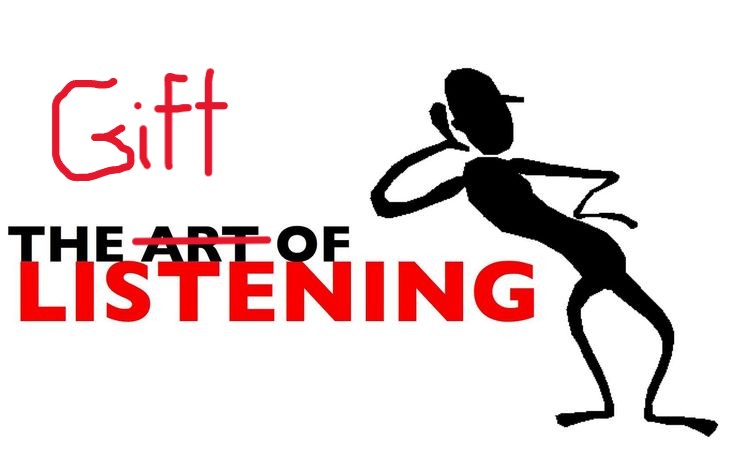
The gift of listening.
Learning to listen — and to listen well — is a skill. It’s a skill that helps the other person feel safe, respected, valued. It helps them feel validated and understood. It builds trust. It’s other-oriented. Other-focused.
I don’t know about you, but sometimes I fall into the trap of half-listening. I hear what is first said, but then my mind goes off on a tangent. It scrolls through possible responses based on past experiences, personal opinions (and sadly, prejudices), something I may have heard or read. By then, I’m not tracking with what the other person is saying. I’m too eager to share MY thoughts!
Some tips I’ve been learning for being a better listener, one who gives the gift of listening:
- Be fully present in the conversation. One way to do that is to turn off your cell phone to avoid the temptation to look at it! Avoid other distractions as well, like people-watching. I often choose a seat in a coffee shop where I have my back to most of the tables so that I can focus more completely on the person I’m with. What things preoccupy you and hinder your ability to focus on the other person? Eliminate them!
- Be aware of your body language. Lean in toward the other person — it communicates that you are wanting to hang onto their every word! Avoid crossing your arms, as if making judgment.
- Be attentive to the other person’s body language and other non-verbal cues. Are they tense? Eager? Anxious? Are they avoiding eye contact with you? Are they fidgety? Do you sense they have more to say… or that they want to end the conversation?
- EYE CONTACT!!! It’s hard to pick up on non-verbal cues if you aren’t looking at the other person! Sometimes the other person is searching for words to express what they’re feeling or perhaps struggling to say what’s really on their heart… and if you aren’t looking at them, it’s far too easy to interpret the pause as a time to jump in with what you’re thinking.
- Give them time! This is especially true if the speaker is a verbal processor, one who needs to “think out loud” to figure out what’s going on inside. I’m a prime example, and this sometimes drives my husband crazy! “Why didn’t you say that at the beginning of the conversation?!?” he groans. “Because I didn’t know what I was thinking then!” I respond.
- Reflect back to them what has been said. Paraphrase what you have heard — to make sure it’s actually what they wanted to say! Ask, “This is what I hear you saying. Is this accurate?”
- Ask questions that encourage further responses — not just “Yes” or “No” answers. Ask them to help you understand ______ better. Or to give more examples. Ask clarifying questions.
- Avoid the temptation of jumping in with solutions. Most people are looking for someone who HEARS them and gives them the space, the freedom to figure out their own solutions.
- Listen to understand… rather than to respond.
- Don’t be afraid of silence. Learn to be comfortable with it.
Learning to listen. The GIFT of listening. A skill that can be learned. A skill that gets better with practice. A skill that is other-focused.
Job’s friends started out well by sitting silently with him, just being there. Sometimes, just being there is all someone needs. But his friends, like me — and possibly you? — needed to grow in their listening skills. By the end of the story, God takes them to task and they own up to their folly (see chapter 42)… so there’s hope!
Yes! Life is a journey, and we’re all in the process — hopefully — of learning, growing. May we encourage one another to look for ways to offer the gift of listening, and together to have joy in the journey of this thing called “Life!”
 Joy in the Journey